What continues after the training?
October 23, 2026
Reflections from a Nairobi field visit
In September 2026, an REI team visited the entrepreneur project funded by REI in Nairobi, Kenya.
The Refugee Engagement and Empowerment Program (REEP) combines business and vocational training (barbering, catering, tailoring, mechanics) with psychosocial support, startup kits and constant follow up.
The timing of the visit turned out to be unfortunate. Just the previous week, the Kenyan government had announced acrackdown on foreign traders. This was not specifically targeted at refugees but certainly influenced the visit as some beneficiaries were experiencing abuse as a result. As Naomi, a member of the visiting team, put it, the visit became a test of how well REI’s funded project holds up under pressure.
Overall participants reported that this project is generating both income and savings. Many described how they movedfrom relying on hawking, or having no work at all, to running a business, saving and in some cases employing other refugees.
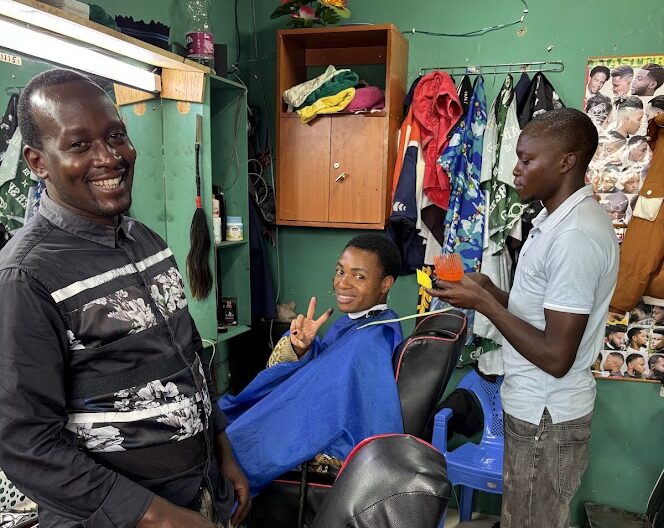
Felix, who arrived from Burundi in 2015, is one example. As a university educated surveyor whose certificates were not recognised in Kenya, he was forced to live day by day as a motorbike taxi driver, without even owning a motorbike. After the training he started a barbering business, began to put savings aside. He now also runs a cyber café and a vegetable farm and employs two refugees.
Income alone can be fragile. What matters most is the skills people carry with them. Even when disruptions hit and businesses are forced to close, the skills people gain stay with them. One beneficiary from Burundi, whose equipment was stolen, said: “but they couldn’t steal my knowledge”.
Gunes, another member of the visiting team, summed it up: “entrepreneurship can leave refugees vulnerable to financial and security risks, but employable skills provide something to fall back on without necessarily requiringcapital”.
Psychosocial support is another important part of the program. It inspires confidence and enables participants to speak up and see themselves as individuals with dignity not ‘just refugees’.
As we see through the field visits, benefits multiply creating a ripple effect. Graduates bring in new clients and some become community mobilisers. Felix, for example, now works as a community mobiliser, introducing other refugees to opportunities and developing a support network.
Word travels in other ways too. Philemon, a former hawker, took part in the business training and opened his barber business in 2025. When Enock, who used to sell on the streets with Philemon, saw how well Philemon was doing, he learned about the training and registered for the program.
Lasting results are not always easily achieved. There are plenty of challenges for refugees as they seek stability. In Nairobi, participants talked about the processes required to get documentation for IDs and work permits; of thediscrimination and hostility towards foreign traders (for example, customers refusing to pay), high rents, unmet basicneeds like food and shifting political conditions. These often overlap, creating complicated situations.
None of this progress is guaranteed, which is exactly why long-term support matters.
Your support turns training into lasting independence.